


A living nitrogen source, working with your crop from day one
VIXERAN® contains Azotobacter salinestris CECT 9690, a free-living, nitrogen-fixing bacteria isolated for its ability to colonise plant roots and foliage. It forms a protective biofilm around the plant and can form cysts to survive hostile conditions, giving it consistent performance across soils, seasons and geographies. In oilseed rape, VIXERAN® supplements nitrogen during the autumn establishment window, when the crop's future branching potential is being decided. More autumn leaves means more spring branching potential and better yield.
+12.5%
Average autumn foliage biomass across 7 German trial sites, 2023–2026
+0.19 t/ha
Average yield uplift, 3-year Germany trial
4.13:1
Return on investment, based on £82.65/ha revenue at £435/t OSR
Key benefits of using VIXERAN® in oilseed rape

Bigger autumn canopy
Extra nitrogen during establishment helps plants build more leaves before winter, and every leaf is a potential branching site in spring.
Greater capacity to compensate
A plant with greater biomass has more leaf area, raising its threshold for compensating for Cabbage Stem Flea Beetle feeding damage. VIXERAN® works alongside your pesticide programme, not in place of it, giving the crop a stronger starting point to grow through pressure.
Proven yield performance, even under nutrient stress
Autumn applications have continued to deliver a positive yield response even in nutrient deficient situations, across multiple trial sites.
More leaves in autumn = more branches in spring
The physical branches don't grow until spring, but the capacity for branching is set by how well the crop establishes in autumn. A plant that produces only 5 leaves before winter is structurally limited to a maximum of 5 lateral branches. The optimum target is 8–10 fully expanded leaves before winter.
VIXERAN® helps supplement the nitrogen available to the crop during this window, supporting stronger, more consistent establishment.
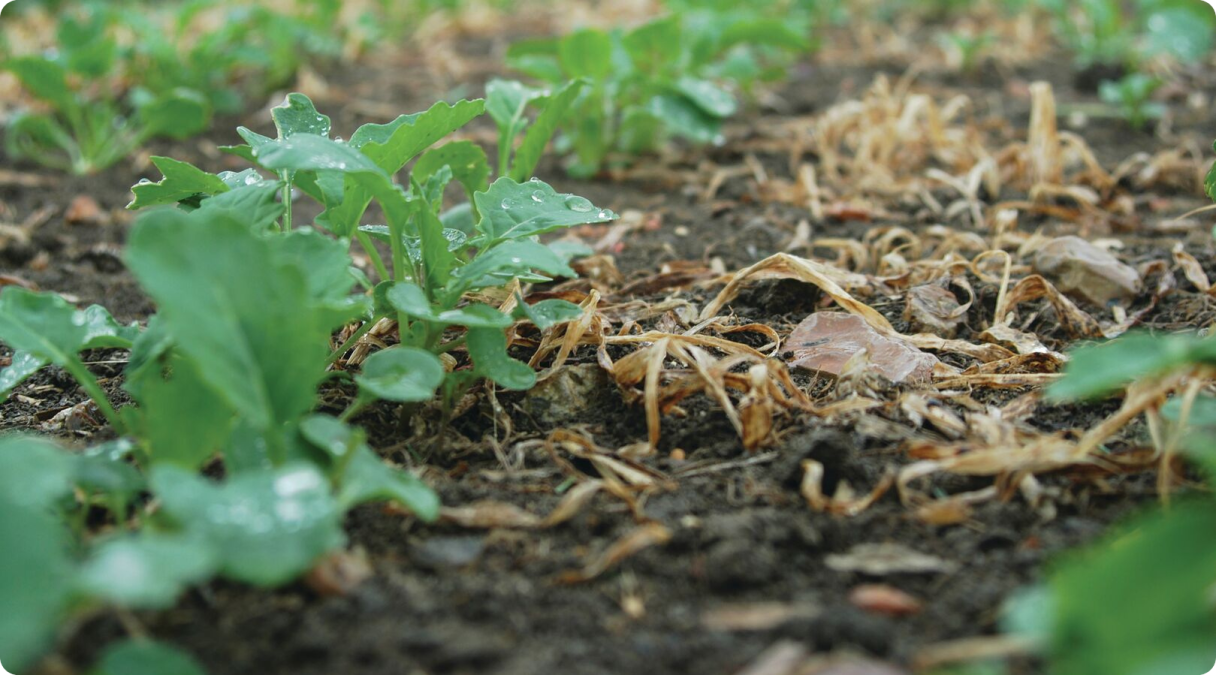
Strong, even establishment in autumn builds the leaf canopy that sets spring branching potential.
Consistent benefits across multiple years and seasons
VIXERAN® autumn use in oilseed rape has been tested at multiple sites across Denmark, Sweden and Germany over several seasons, with applications consistently improving pre-winter biomass and final yield.
Biomass increase before winter (g/m2)
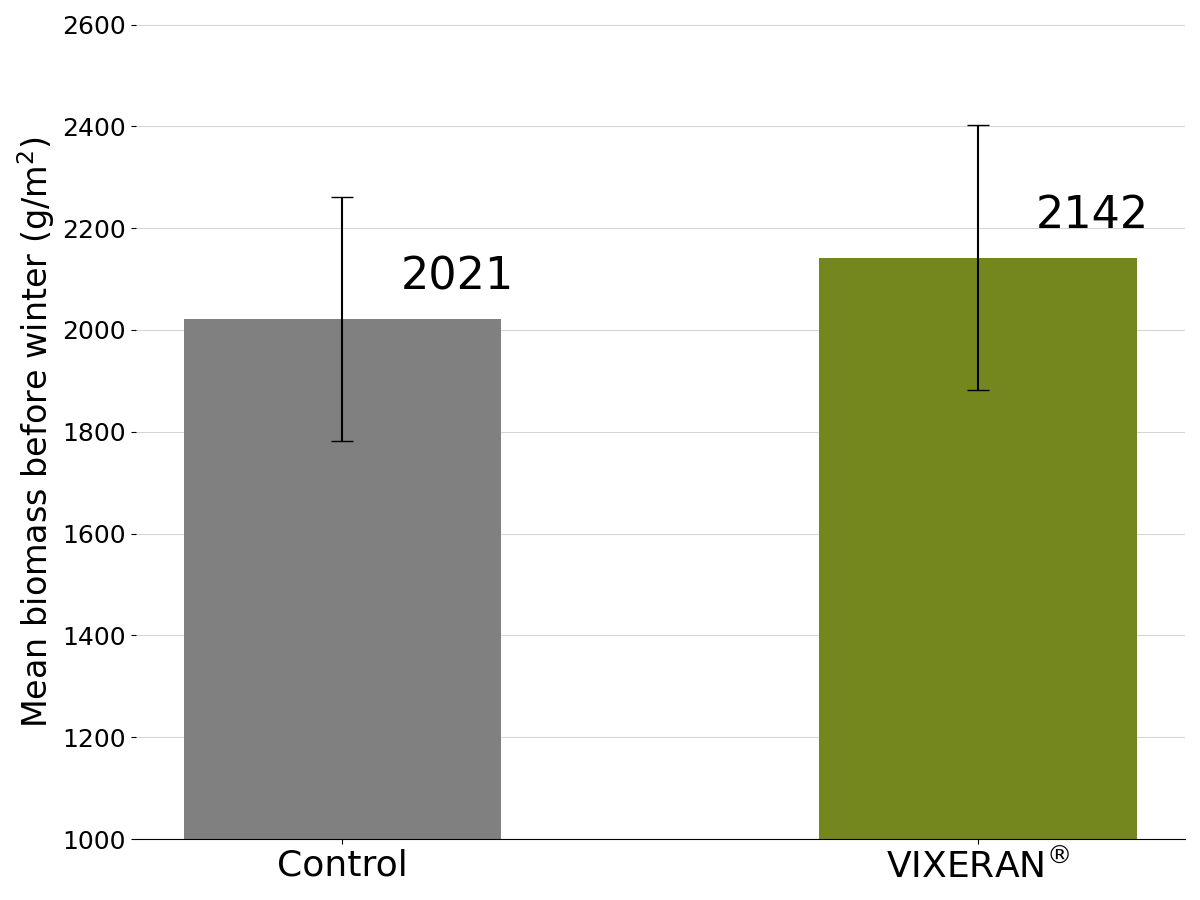
+8.0%
Where biomass was taken in the farm-scale demonstration network, mean autumn biomass increase before winter (BBCH 14–15 application) — more leaf area for the crop to draw on under CSFB pressure.
Biomass increase turned into yield (t/ha)
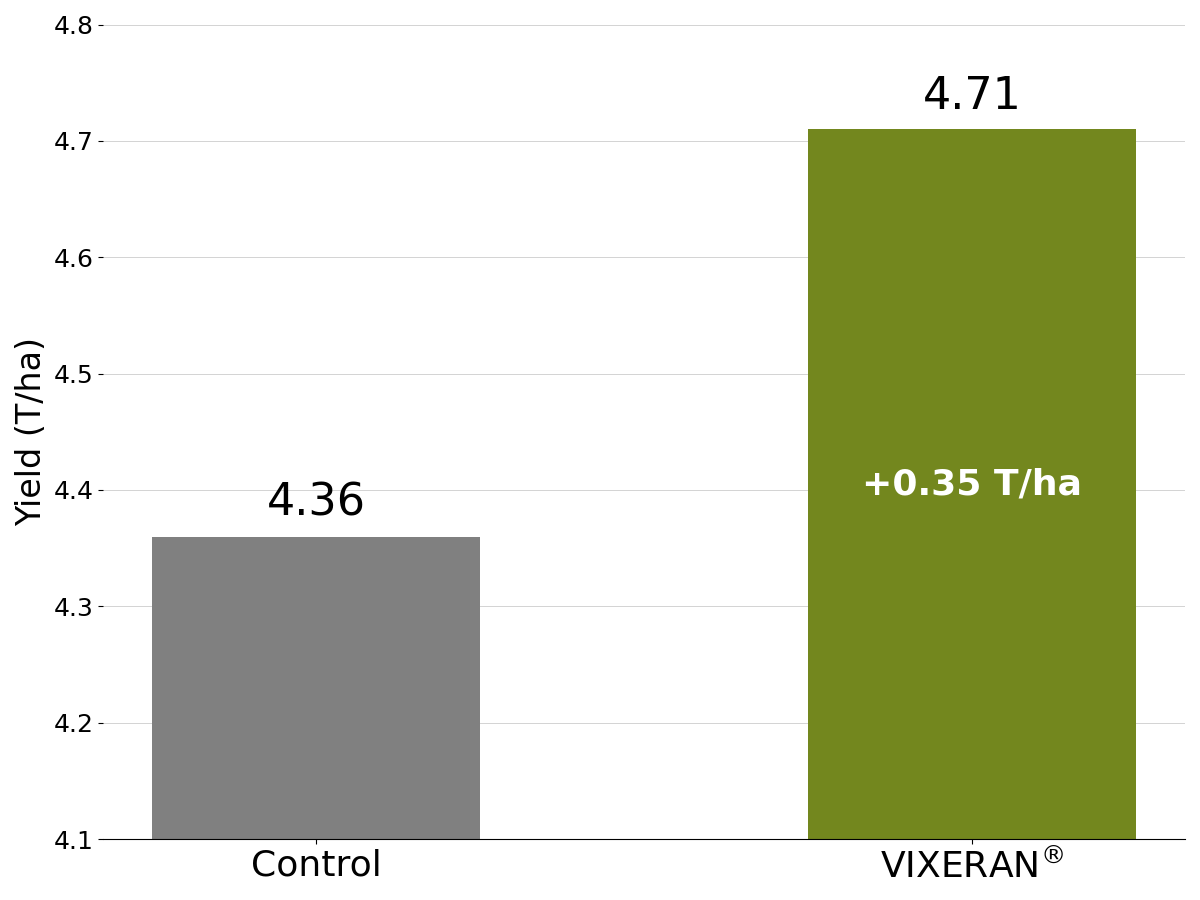
+0.35 t/ha
Average seed yield increase across the same 17 farm-scale demonstration trials as the biomass result above.
Yield gains repeat across seasons (t/ha)
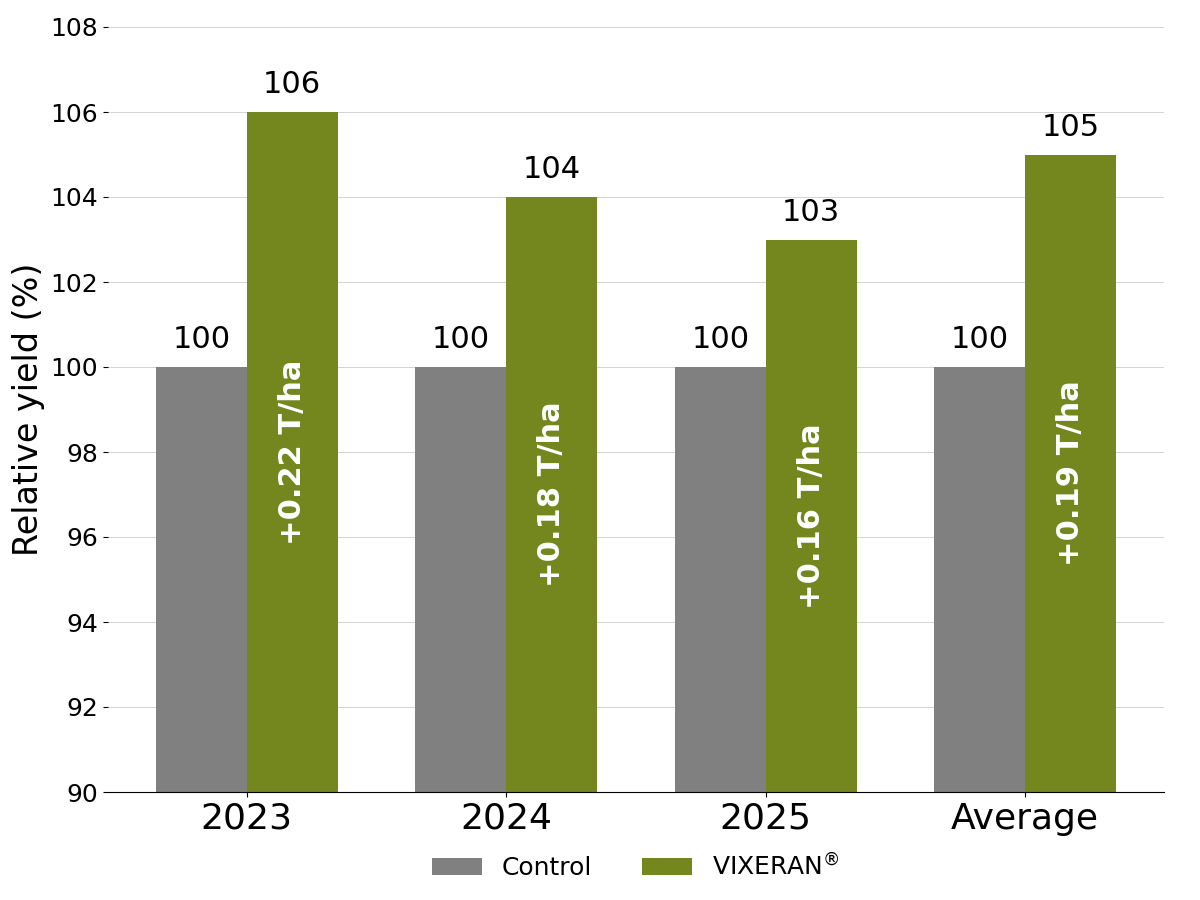
+0.19 t/ha
Average yield uplift across 3 consecutive harvests (relative yield 104.5% vs control).
Yield holds under limited nitrogen (kgN/ha)
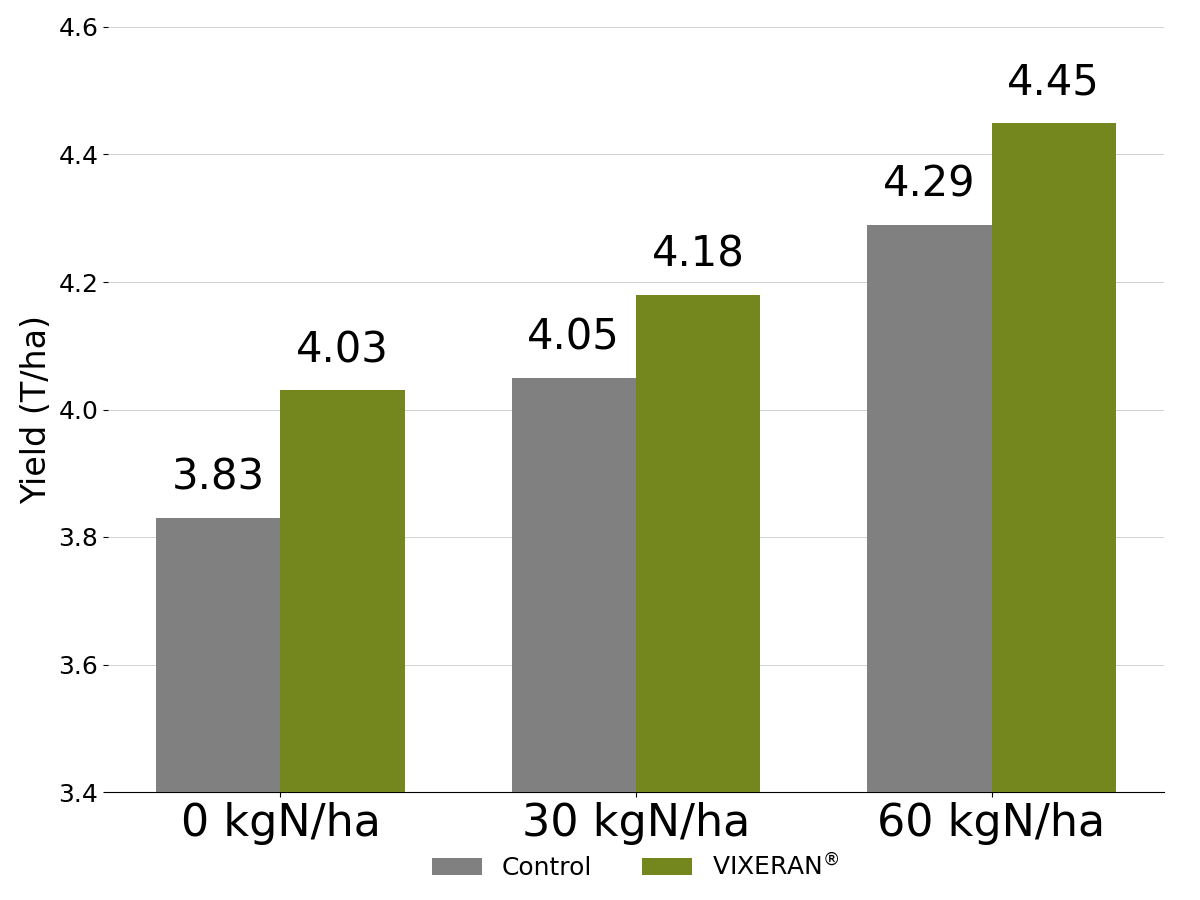
+0.16 t/ha
Average yield increase across three autumn nitrogen rates (0, 30 and 60 kgN/ha) - evidence that VIXERAN® continues to perform well in nutrient deficient situations.
UK trials point to spring as a good option where spring nitrogen is required: across two UK trials (Deighton Grange, North Yorkshire and Tiptree, Essex), a spring application gave an average yield increase of +0.27t/ha.
What growers are saying about VIXERAN®
Feedback from the farmers hosting our on-farm demonstration trials in oilseed rape.

Our expectation for VIXERAN® is that if we can see even a small difference, a plant that's a bit more robust, with something to stand on, then that's good enough for us.
Søren
Kragerup Estate

We harvested almost 400kg more oilseed rape with VIXERAN®. It mixes with most other products too, and that matters a lot. We don't need to run it through the sprayer on its own.
Søren
Kragerup Estate
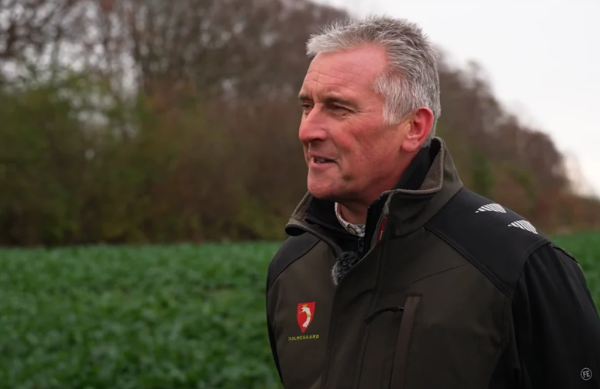
With VIXERAN® I can see a 0.4kg difference in biomass cuttings, which works out to around 25kg N, whereas maximum fertiliser rates showed no difference at all, with or without VIXERAN®.
Thomas
Holmegaard Estate
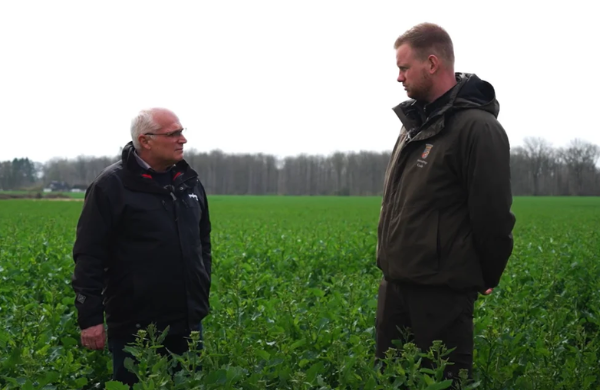
VIXERAN® is easy to handle and mixes really well. I can tank-mix it with almost everything I want to use in oilseed rape in the autumn.
Andreas
Svenstrup Estate
How and when should you apply VIXERAN®?
The choice is yours to make: invest in the canopy in the autumn, while there's still time to influence growth, or apply in the spring at stem extension, the crop's highest nitrogen-demand stage. Pick your path below.
Invest before winter
Build canopy in the autumn, to help the crop better withstand CSFB pressure and to boost vegetative growth before winter. Your exact approach depends on drilling timing, CSFB pressure and Soil Mineral Nitrogen (SMN) status — find your drilling timing below and follow the tree to a recommendation.
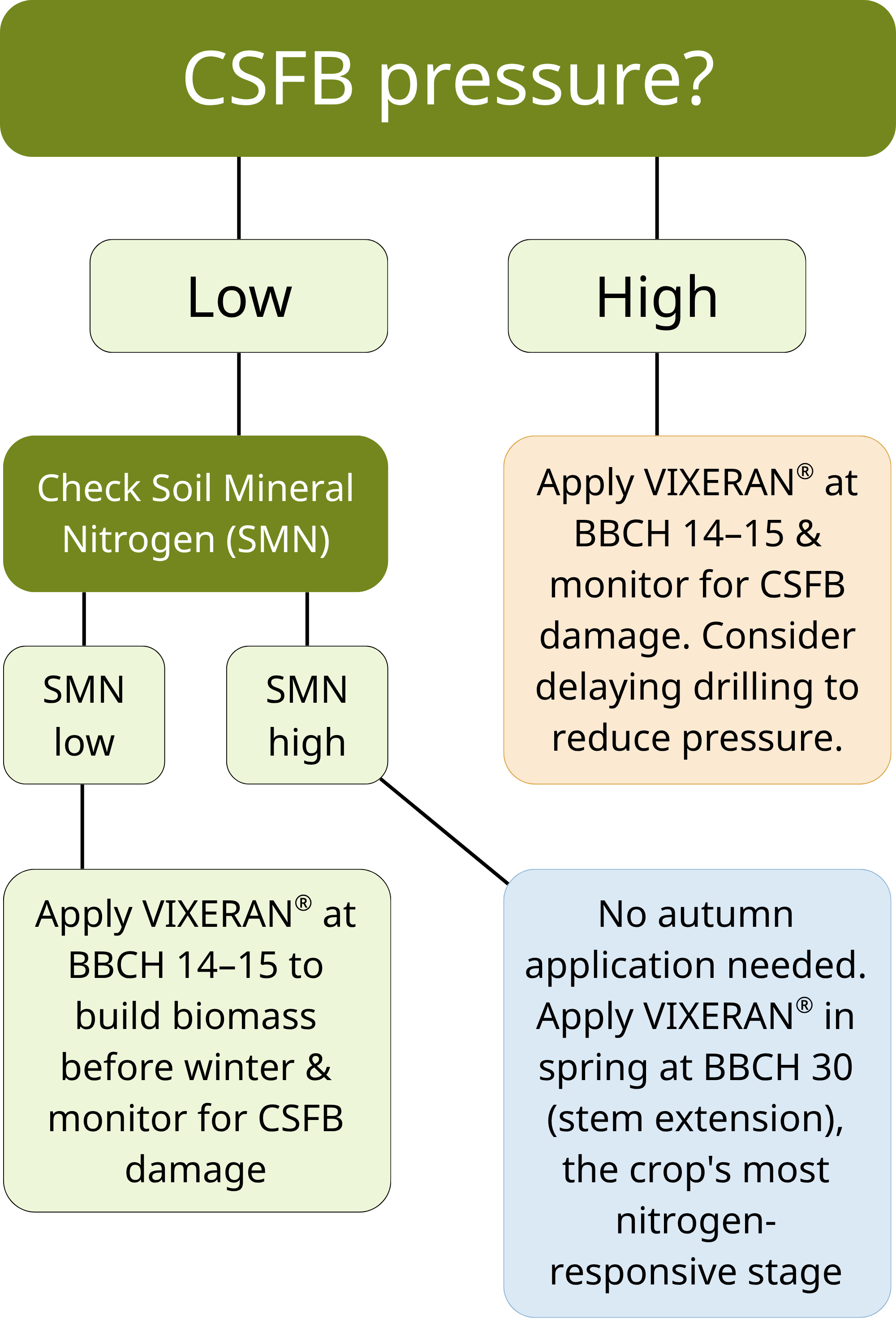
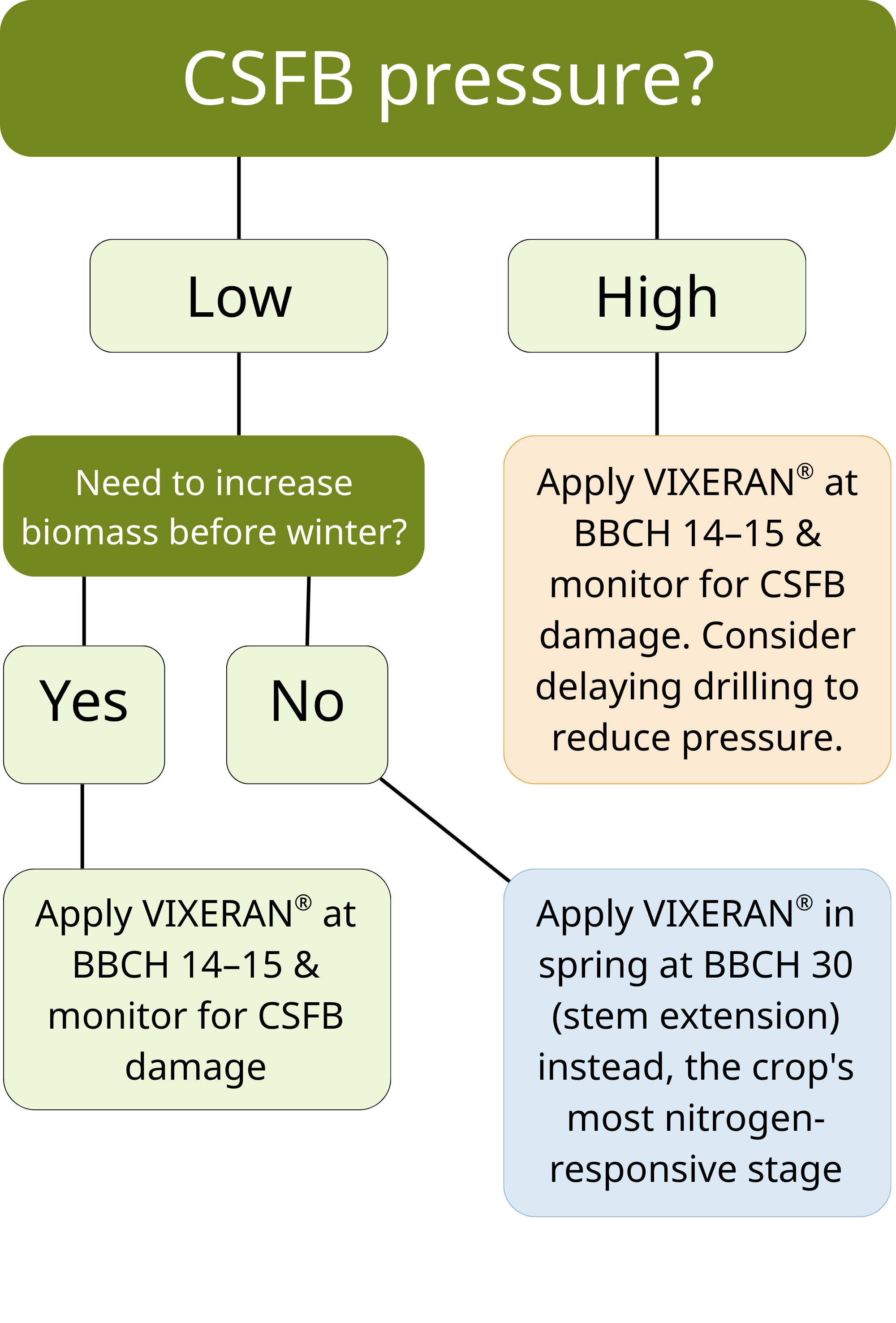
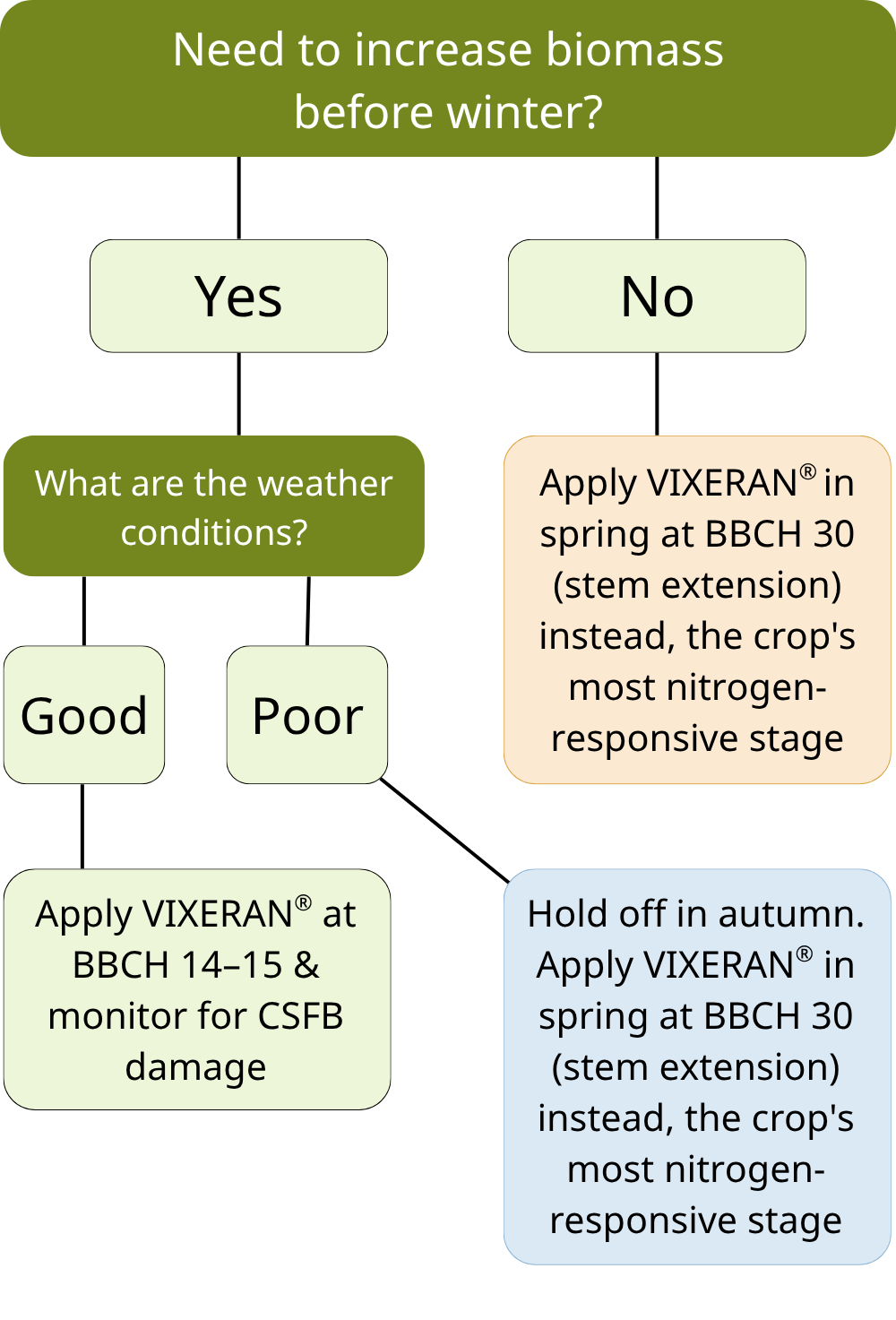
Apply in spring
Didn't get an autumn application on, or waiting until spring to decide? Stem extension (BBCH30) is the crop's highest nitrogen-demand stage, with rapid biomass growth — nearly every crop benefits from VIXERAN® here if it hasn't already been treated.
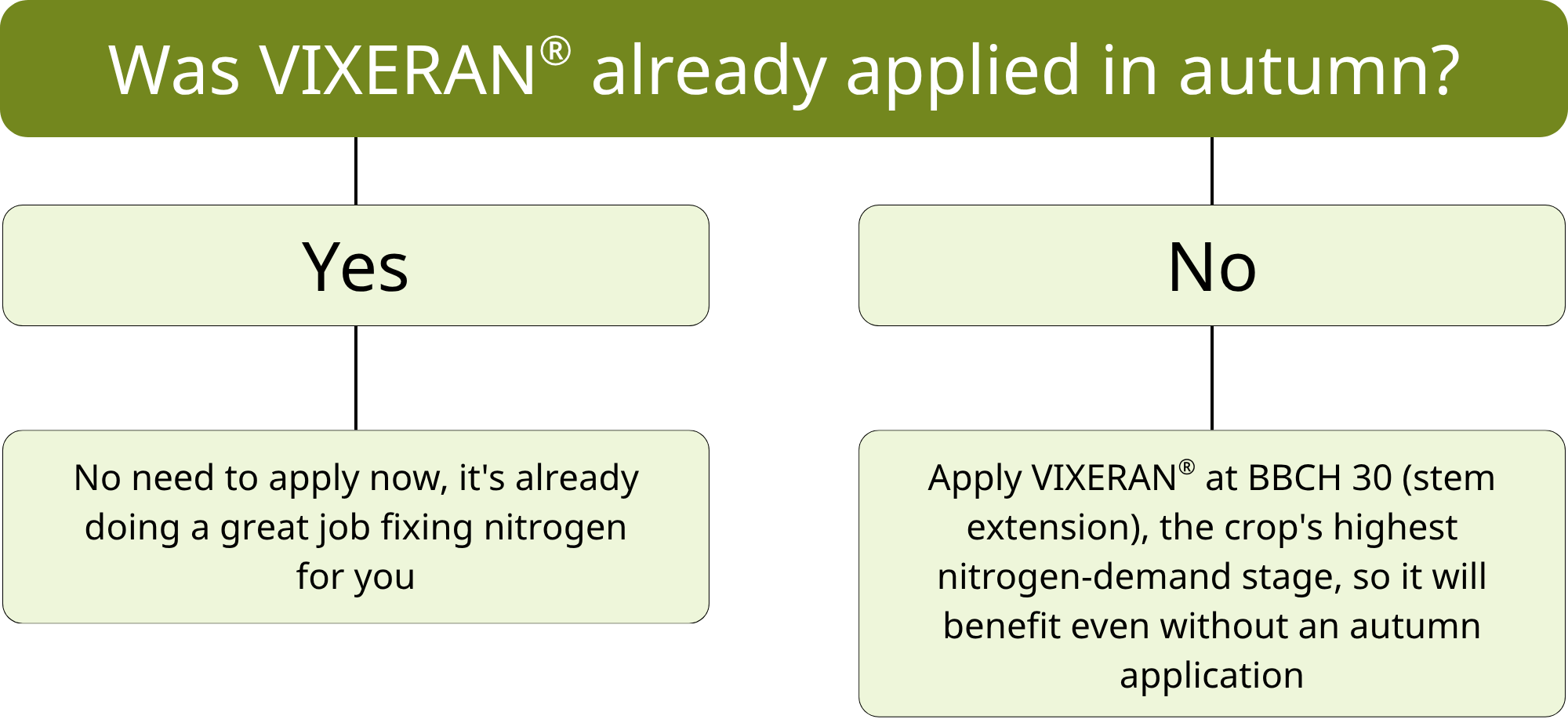
Getting the timing and technique right

Playing this video requires a marketing consent.
Click anywhere on the video to renew your consents.
| Timing | Growth stage | Dose rate | Water volume |
|---|---|---|---|
| Early establishment (primary window) | BBCH 13-15 | 50g/ha | 100-400 litres/ha |
| Spring (alternative timing) | BBCH 30 (start of stem extension) | 50g/ha | 100-400 litres/ha |
Apply when air temperatures are above 5°C, ideally 10–12°C, for enhanced bacterial activity. Avoid application if prolonged temperatures below 5°C are expected in the following days, as this slows colonisation.

Preparation
VIXERAN® is a wettable powder. Ensure a uniform distribution in the final tank solution. Add one whole sachet (e.g. 250g) to at least 1.25L of water above 5°C, mix thoroughly, then add to the required water volume. Agitate continuously and apply on the day of preparation.
Tank mixing
VIXERAN® can be tank-mixed with most other crop protection products used in oilseed rape, but check compatibility first. Dilute other products with water before adding VIXERAN®. Note: other Syngenta markets flag VIXERAN® as incompatible with Focus Ultra — to confirm before including on the UK compatibility list.
Water quality
VIXERAN® remains active in water up to 2ppm chlorine, 20g/L calcium carbonate, and pH 5.5–9.0.
Organic use
VIXERAN® is certified for use in organic production systems. Consult your certification body prior to use.
Common questions about VIXERAN® in oilseed rape
What is VIXERAN®?
VIXERAN® is a biofertiliser containing the free-living, nitrogen-fixing bacteria Azotobacter salinestris CECT 9690. It colonises both the roots and foliage of the crop, fixing atmospheric nitrogen and making it available when the plant needs it most.
Why use VIXERAN® in oilseed rape specifically?
Oilseed rape has a high nitrogen demand during autumn establishment and is uniquely vulnerable at this stage. The size of the autumn canopy directly determines how many branches the crop can produce the following spring, so supporting nitrogen availability early has an outsized effect on final yield potential. The crop is nitrogen-responsive again in spring at stem extension (BBCH 30) when it's rapidly building biomass, so VIXERAN® has a real role in both autumn establishment and in spring.
Does VIXERAN® help with Cabbage Stem Flea Beetle pressure?
VIXERAN® is not a pesticide replacement, but a plant with greater biomass has more leaf area to lose before yield becomes limiting, which can raise the crop's threshold for compensating CSFB feeding damage.
When should I apply VIXERAN®?
There are two strong windows. Early establishment, around BBCH 13–15, builds canopy and branching potential before winter. Stem extension, BBCH 30 in spring, is the crop's most nitrogen-responsive stage with rapid biomass growth. If VIXERAN® hasn't gone on in autumn, this spring window is always worth using.
What conditions are needed for a good application?
Apply when the crop is actively growing and air temperatures are above 5°C, ideally 10–12°C. Avoid application if prolonged temperatures below 5°C are forecast in the days after, as this slows bacterial colonisation.
Ready to plan your VIXERAN® autumn programme?
Talk to your agronomist or Syngenta representative about fitting VIXERAN® into your oilseed rape establishment plan this autumn.
Find your local contact
Visit the Biologicals Hub
Explore
VIXERAN® compatibility list
Download PDF