


VIXERAN®: Boosting Nitrogen Efficiency in Pulse Crops
Nitrogen is the cornerstone of growth and development in leguminous crops. While these plants are renowned for their ability to fix their own nitrogen, VIXERAN® offers a groundbreaking solution to enhance this natural process and overcome common limitations.
The nitrogen cycle in legumes: A delicate balance
Legumes form root nodules 3-5 weeks after emergence, which actively fix nitrogen for the plant's use. However, as the crop reaches the critical pod-filling stage, these nodules begin to senesce.
This forces the plant to redirect nitrogen from its foliage to fill the seeds, potentially compromising overall plant health and yield.
Key benefits of VIXERAN® in pulse crops

Complements rhizobium
Improved yield potential
Better crop structure and green leaf area leads to increased nitrogen availability
Optimised crop performance
Provides nitrogen at critical pod-filling stage when nodules begin to senesce

Why use VIXERAN®?
A legumes crop's ability to utilise and fix nitrogen can be limited by various factors, and VIXERAN® can help to supplement or reduce the burden of them, leading to improved growth, development and final yield.

Soil nitrogen reserves
Environmental conditions, like excessive rainfall, can reduce the amount of nitrogen in the soil. VIXERAN® will increase the availability as needed by the pulse crop.
Rhizobium levels
The levels of nodulation is affected by the number of rhizobium bacteria in the soil. VIXERAN® can be used to supplement the nitrogen that is fixed by the rhizobium.
Pest activity
Pest activity, such as pea and bean weevil larvae, can impact on the nodule effectiveness. VIXERAN® will compensate for any loss of nodules through the season.
Plant structure
VIXERAN® enhances plant structure and green leaf area (GLA), increasing nitrogen availability for seed fill. Also, VIXERAN® reduces the burden of the leaves to provide all the nitrogen, prolonging GLA retention.
How to optimise the application of VIXERAN® in pulse crops
VIXERAN® contains a living organism; therefore, this application advice is designed to support bacterial activity and a quick and effective colonisation.

Playing this video requires a marketing consent.
Click anywhere on the video to renew your consents.
| Preparation | It is best practice to premix wettable powders. Add 1 sachet of VIXERAN® to min. 1.25L of water. Warmer water (+ 5°C) will make it solve quicker. VIXERAN® can be added directly to the induction hopper with the recommended volume of water if required, but ensure it is poured in gradually to avoid clumping. |
| Tank mix | VIXERAN® can be tank-mixed with other crop protection products for convenience, but check compatibility prior to use. When tank mixing, dilute other products with water first before adding the VIXERAN®. |
| Temperatures | To ensure successful colonisation, the crop should be actively growing. The ideal temperature is above 10-12°C. The minimum air temperature before and after application is 5°C. Preferably avoid applying where temperatures are forecast below 0°C in the following 5 days. |
| Timing | The ideal timing is early crop stages. Covering both foliage and soil is preferable as the bacteria colonise leaves, roots and rhizosphere. Apply during the day when the plant’s stomata are open. Apply from 6 true leaves to first flower stage, typically in early to mid-May. |
| Water volume | Use a water rate of 100-200 l/ha and a medium droplet size to ensure even distribution across foliage and soil, ideally in early morning or late afternoon. |

Ideal crop stages for application
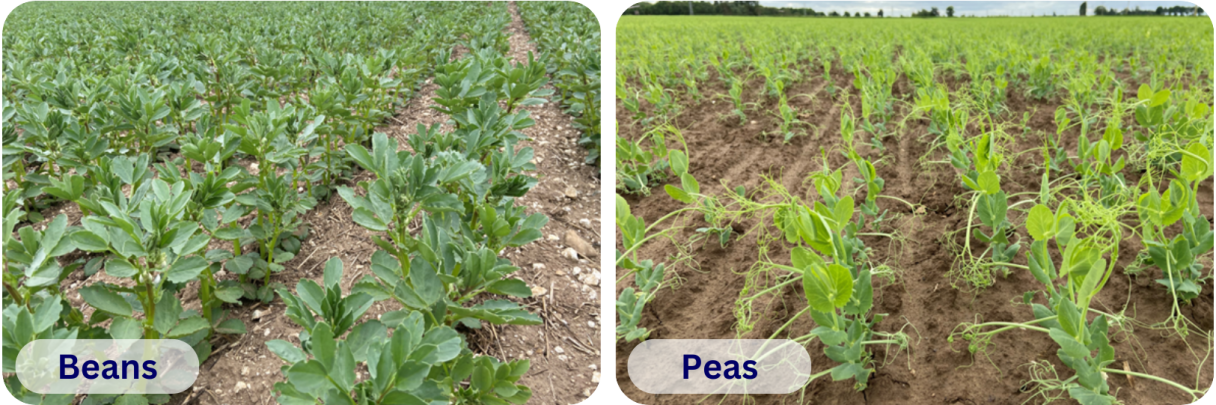
VIXERAN® trials in beans: 12.7% yield improvement

VIXERAN® was tested across 4 sites in 2023 (2 Spring beans, 2 Winter beans) to assess its impact on yield.
Results showed:
• Average yield increase: 12.7%
• Absolute yield increase: 0.51 t/ha
• Control yield (treated with fungicide only): 4.17 t/ha
• VIXERAN® treated yield (fungicide + VIXERAN®): 4.68 t/ha
VIXERAN®, applied at the start of flowering, helps overcome factors limiting nitrogen fixation and utilisation in legumes. By supplementing natural processes, it enhances growth, development, and final yield in bean crops.

VIXERAN® split field trial 2024: 1.47 t/ha yield benefit in combining peas:
Crop treated with VIXERAN® (6.91 t/ha) showed a large yield increase over the farm standard (5.44 t/ha), resulting in an overall benefit of 1.47 t/ha (+27%).
Location: Brodsworth, South Yorkshire. Variety: Kameleon. Application date: 24th May at BBCH 16
Q&A: VIXERAN® in pulse crops



Related news

01.03.2025Biostimulants
While legumes can fix nitrogen, VIXERAN® enhances this process and helps overcome common limitations. It supplements natural nitrogen fixation, especially during critical growth stages when nodules begin to senesce, ensuring consistent nitrogen availability throughout the crop cycle.