
Building Profitable, Resilient Farming Systems
We've been working with project partners GWCT, Niab and Yara to develop regenerative agriculture systems that deliver on two fronts - productive, profitable crops and measurable improvements to soil health, carbon capture, and biodiversity. Based at trial sites on heavy land in Leicestershire and light land in Kent, this long-term project is testing how optimised inputs and reduced tillage can create a farming system that works harder for both the business and the environment. It builds on five years of conservation agriculture research, and it's designed with real cereal rotations in mind - not theory.
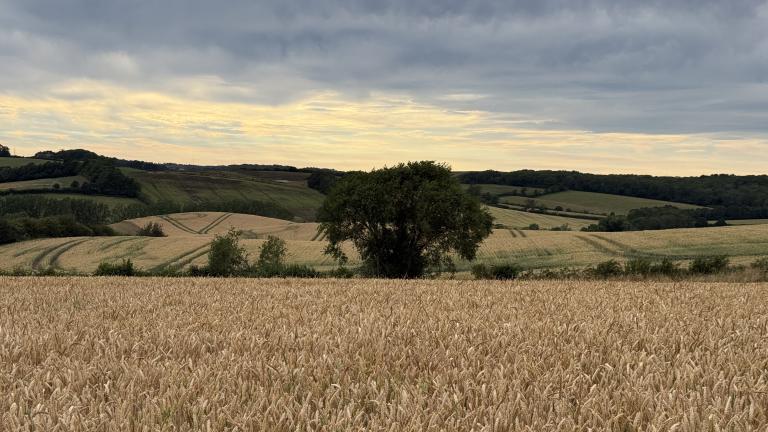
Three approaches, side by side
We're running three cultivation systems in parallel across both UK sites. Each represents a different level of soil disturbance and input management - so we can see exactly where the gains are, and where the trade-offs sit.
Conventional
Mostly inversion of soil or minimum tillage, where required, standard inputs and no inclusion of cover crops.
Light-till
Light till/ Direct Drill with cover crops integrated into the rotation and standard inputs.
Light-till Plus
The same light till/ direct drill and cover crop approach, but with augmented input management. Organic matter additions, weed control alternatives, biostimulants, synergistic strategies with a field focused on each criteria. testing whether targeted decisions on nutrients, biostimulants, and crop management can deliver the environmental benefits of light-till without compromising yield and profitability.
Our sites
Loddington
- Heavy land site
- 5 fields split 3 ways to cover each scenario
- 5 year rotation: Hyvido-OSR-WW-S Beans/Peas-WW
Lenham
- Light land site
- 4 fields split 3 ways to cover each system
- 5 year rotation: WW-SB-S Beans-WW-OSR
Conservation Agriculture: What 5 years of UK field data has proved
Between 2017 and 2022, we ran a five-year conservation agriculture trial across two UK sites: Loddington in Leicestershire and Lenham in Kent. The trial formed part of the wider European conservation agriculture project and compared three farming systems within a full cereals-based rotation.
The purpose was to evaluate whether conservation agriculture principles could support growers moving towards more sustainable production without sacrificing what matters commercially. Five years of data gave us a clear answer across both soil types:
Loddington: Heavy land site in Leicestershire, providing a test of conservation agriculture on heavier UK land.
Lenham: Light land site in Kent, providing a contrasting soil type and growing environment.
What this told us: Reduced tillage and cover crops can work commercially on UK arable land
These five years confirmed that reduced tillage with cover crops can deliver measurable environmental and economic benefits across contrasting UK soil types.
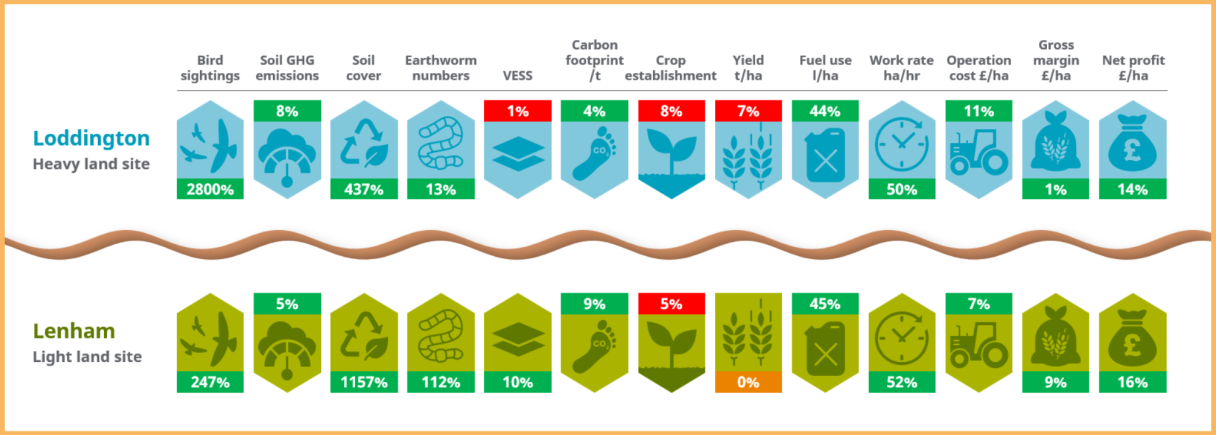
The trial included improved soil cover, greater earthworm numbers, lower fuel use, faster work rates and increased net profit. The trial also raised the next question: can a light-till system be actively managed through smarter inputs, biostimulants and precision technology to close the remaining yield gap and go further?
Syngenta 5-year summary UK
All results compare Sustainable System 2, using direct drill or light till, against the Conventional System using ploughing. Results are averaged across the seasons: four years at Lenham and five years at Loddington.
Regenerative Agriculture Project in Leicestershire with X-TERRA® hybrid wheat
The X-TERRA® wheat trial at the GWCT Allerton Project in Leicestershire follows the crop from establishment to harvest as part of a long-running regenerative agriculture trial. The summary below compares plough-based and lower-disturbance systems, including results for yield, crop development, soil indicators and grain quality.